
SoLo Funds: Lend & Borrow
Solo FundsFinance
4.65.63K Reviews
- Version
- 2.19.0
- Installs
- 500.00K
- Age Rating
- Everyone
Screenshots
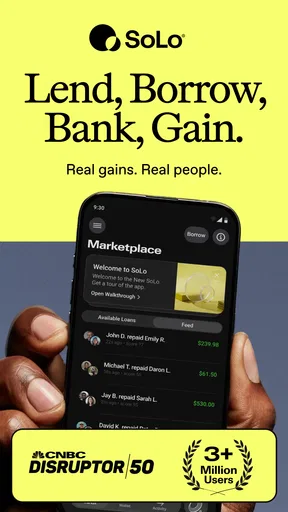
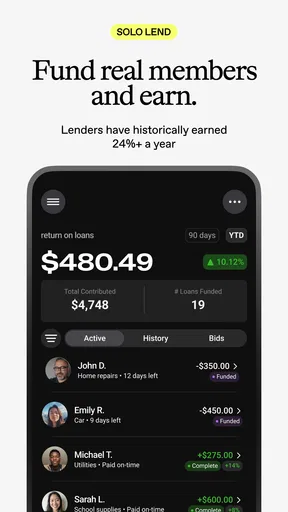
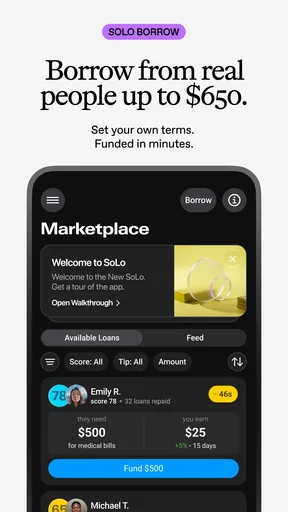
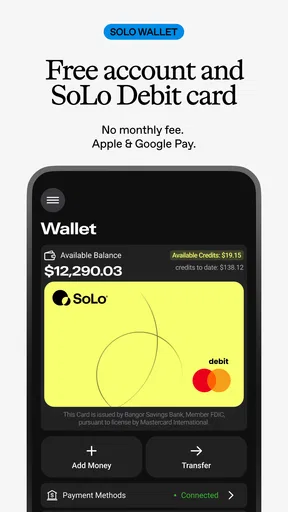
Our Review of SoLo Funds: Lend & Borrow
 Analysis by Appyee
I approached SoLo Funds as a practical finance app rather than as a replacement for a bank. Its central idea is simple: people can request short-term help from other members, while members who have money available can choose to lend it. That makes the experience feel more personal than a conventional loan marketplace, but it also means the app deserves a more careful look than its brief store description suggests.
My overall view is positive but conditional. The app can be useful when a modest, urgent expense appears and the usual choices are expensive, slow, or simply unavailable. At the same time, I would not treat it as a guaranteed emergency fund or as an effortless way to make money. The value depends heavily on timing, repayment discipline, and how comfortable you are with the uncertainty that comes with community-based borrowing and lending.
How the borrowing and lending experience feels in practice
SoLo Funds sits in the finance category and is developed by Solo Funds. It is free to download, aimed at Everyone, and supports devices running Android 8.0 or later. The app has built a sizeable audience, with over 500 thousand installs, a 4.6 average from around 25 thousand ratings, and roughly 5.6 thousand written reviews. Those figures suggest that the concept is reaching real users, although popularity alone does not remove the need to understand how the model fits your own finances.
The first thing I noticed is that this is not the same experience as opening a standard line of credit. A traditional lender evaluates an application through its own underwriting process and then gives you a fixed decision. SoLo Funds is built around a member-to-member arrangement. A borrower asks for help on their own terms, and lenders decide whether a request is suitable for them. That difference changes the emotional and practical rhythm of the app.
For a borrower, the appeal is flexibility. An unexpected grocery bill, a transportation problem, or a small gap before payday can be easier to explain through a community request than through a formal loan application. You are not approaching the app as though you are shopping for a large, long-term financial product. You are trying to solve a specific short-term problem.
For a lender, the attraction is the possibility of supporting another person while receiving the benefit associated with the arrangement. However, I would be cautious about thinking of every request as a predictable investment. A request may sound reasonable and still carry repayment uncertainty. The lender’s decision therefore requires judgment, not just enthusiasm about the potential return.
The strongest part: it addresses a real short-term problem
The best case for this app is a narrow one, but it is meaningful. Many people do not need a large loan; they need to bridge a small timing mismatch. Their income may arrive soon, yet an essential expense cannot wait. In that situation, a conventional credit card cash advance, overdraft, or payday-style product may create more cost and stress than the original problem deserves.
SoLo Funds gives that kind of user a different route to consider. The app’s community structure makes the request feel less like a faceless application and more like a direct appeal to people willing to participate. That does not guarantee approval or instant access, but it can be more approachable for someone who wants to explain a short-term need instead of entering a lengthy borrowing relationship.
A realistic example would be a person whose paycheck is scheduled for later in the week but who needs to cover a necessary household purchase today. I would use the app only after checking the exact repayment obligation against the incoming paycheck. If the repayment would leave no room for food, transport, or another unavoidable bill, the request is not truly solving the problem; it is moving the pressure a few days forward.
That is one of the most important practical lessons I took from the service: the app works best as a carefully planned bridge, not as recurring income support. Used occasionally and with a clear repayment plan, it may be helpful. Used every time the budget runs short, it can become part of the cycle causing the stress.
Why the social model changes the decision
The member-based structure is also the app’s most distinctive quality. With a conventional lender, the institution makes the decision and absorbs the business risk according to its own rules. Here, the person lending money has a more direct role. That can create a stronger sense of choice, but it also places more responsibility on the user.
If I were considering a lending request, I would slow down rather than approving it based only on a sympathetic explanation. I would think about whether the amount is sensible, whether the repayment timing appears realistic, and whether I could tolerate a delay without affecting my own bills. A lender should never use money needed for rent, utilities, debt payments, or an upcoming emergency.
This is a non-obvious trade-off: the app may feel more transparent or human than a standard financial product, yet that human element can make decisions harder. A polished bank interface may hide the fact that lending is still a risk. A community interface can make the person behind the request more visible, which is valuable, but it may also encourage an emotional decision.
My advice is to separate compassion from affordability. You can respect someone’s situation and still decide not to lend. Likewise, a borrower should not assume that a sincere explanation creates an obligation for another member to provide funds. The app is more useful when both sides treat the arrangement seriously.
Where the app can become frustrating
The main weakness is uncertainty. A user who needs money at a precise moment may find that a community-based request does not behave like an automatic approval system. Availability depends on participation and timing, so I would not build a critical payment plan around the assumption that a request will be funded exactly when needed.
That limitation matters most during emergencies. If a bill is due within hours, the app may not be the right first option. I would check safer resources available through my bank, employer, family, local assistance services, or an existing credit arrangement before relying on a marketplace whose outcome depends on other members.
Borrowers also need to pay close attention to the full obligation rather than focusing only on the amount received. Before accepting anything, I would review the repayment date and every cost or contribution shown in the app. A small amount can still be difficult if it is due before the next realistic income date. The right question is not “Can I get this money?” but “Can I repay it without creating another shortfall?”
Lenders face a different kind of friction. The possibility of receiving a benefit can make the arrangement look attractive, but the money is not equivalent to cash kept in a savings account. I would treat every loan as money that may be unavailable for longer than expected. Anyone seeking guaranteed access, predictable interest, or the protections and simplicity of a conventional savings product should look elsewhere.
There is also a learning curve in understanding the roles. A new user may open the app thinking primarily about borrowing, then discover that the platform also invites participation as a lender. That dual purpose is interesting, but it means the app is not as straightforward as a single-purpose budgeting tool. I found it helpful to decide which role I was evaluating before judging the rest of the experience.
How it compares with familiar alternatives
Compared with a bank overdraft, SoLo Funds may feel more personal and potentially more flexible, but a bank can be more predictable when an account already has an established facility. The bank’s process may be less emotionally appealing, yet the user generally understands where the decision comes from and what account will be affected.
Compared with a credit card, the app is more focused on a specific short-term request rather than ongoing spending. A credit card can be convenient for a purchase and may offer a known billing cycle, but it can also encourage carrying a balance. SoLo Funds may appeal to someone who wants to keep a borrowing request separate from everyday card spending. It is not automatically cheaper or safer, though; the user still needs to inspect the terms and repayment impact.
Compared with payday lending, the community approach may look less impersonal and may suit someone trying to avoid a traditional high-pressure borrowing experience. Still, I would not make a blanket claim that one option is always best. The correct comparison depends on the exact amount, the repayment date, the total obligation, and the consequences of missing payment. A user should compare those details rather than choosing based on the product’s friendly tone.
Compared with a budgeting app, this service solves a different problem. A budgeting app helps you plan money you already have or expect to receive. SoLo Funds can help address a temporary gap, but it does not replace the planning function. In fact, pairing the two approaches makes more sense to me: use a budget to identify why the gap occurred, and consider borrowing only if the short-term need is unavoidable and repayment is genuinely manageable.
Small habits that make the experience safer
I would begin by defining the exact purpose of a request before opening the app. “I need extra money” is too vague to guide a sound decision. “I need a specific amount for a necessary expense and can repay it from a confirmed income source on a specific date” is much clearer. If I could not write that second sentence honestly, I would pause.
My second habit would be to calculate the repayment in the context of the whole week, not just the next payday. A repayment that technically fits on paper may still cause trouble if groceries, transportation, or another automatic payment arrives first. I would leave a buffer instead of treating every expected dollar as available.
For lenders, I would set a personal limit before reviewing requests. That prevents the app from turning into an impulsive search for opportunities. I would only use money that is genuinely spare, divide it across decisions only if I could accept the associated uncertainty, and avoid assuming that a displayed benefit is the same as guaranteed income.
A third useful habit is to keep records outside the app. I would note the amount requested, the amount that must be repaid, and the date that matters. This is especially helpful if I use the service more than once, because separate short-term arrangements can blur together. A simple calendar reminder can prevent a manageable obligation from becoming an avoidable surprise.
Finally, I would update my expectations after each use. If the process takes longer than expected, if the repayment timing strains the budget, or if the overall cost feels uncomfortable, that experience is evidence for changing course. The app should remain an occasional tool, not something I feel pressured to keep using because it solved one earlier problem.
Who will appreciate it, and who should skip it
I think SoLo Funds is best suited to financially organized adults who occasionally face a small timing gap and can identify a dependable repayment source. It may also suit people who prefer a community-based option and are willing to read the details carefully rather than expecting a fully automated financial product.
It is less suitable for someone with unstable income, repeated overdrafts, or several existing repayment obligations. If the next payment depends on another loan, another request, or an uncertain paycheck, borrowing is likely to postpone the underlying problem. In that situation, a conversation with a bank, nonprofit counselor, employer, or trusted support network may be more useful than adding another obligation.
I would also steer away from using it as a casual lending game. The possibility of a return should not be the reason someone risks money needed for daily life. Users who want passive, predictable earnings may be happier with a regulated savings product or another financial option designed around clearer access and lower personal decision-making.
The app is free, which lowers the barrier to trying it, but “free to download” should not be confused with “free in every financial sense.” The important evaluation happens inside each arrangement. I would read the displayed terms, understand the repayment responsibility, and avoid making a decision until the total impact is clear.
What the current app details suggest
The app was released on October 22, 2021, and its current version is 2.19.0. That gives the product an established presence rather than the feel of a brand-new experiment. I still would not let the version number or the strong average rating replace my own review of a particular request. Finance apps affect real obligations, so personal suitability matters more than a general impression.
The Everyone content rating makes the app broadly accessible from a store-classification perspective, but the financial decisions inside it are not equally appropriate for every person. Younger or inexperienced users may need help understanding repayment, risk, and the difference between a short-term bridge and a sustainable budget. Accessibility of the download does not remove the need for financial maturity.
The developer, Solo Funds, has positioned the product around both sides of the transaction: borrowing and lending. That is useful because it gives the platform a clear identity, but it also means the app asks users to think beyond the usual “apply and receive” pattern. I appreciate that distinction, while still believing that the service should be approached with the caution I would apply to any financial commitment.
My final assessment
After looking at the app as both a borrowing tool and a lending marketplace, I see a focused product with a worthwhile purpose and a real boundary. Its strongest quality is that it recognizes a common financial reality: a person can be responsible overall and still face a short gap at the wrong time. A member-based request may offer an alternative to more rigid or costly choices.
Its weakness is equally clear. The outcome is not as predictable as a standard account feature, and the responsibility for making a sensible decision remains with the user. Borrowers must know exactly how repayment fits into their budget. Lenders must be comfortable with uncertainty and must never risk money they need. Neither side should mistake a friendly community model for a guarantee.
I would recommend trying SoLo Funds to someone who has a specific, temporary need, a realistic repayment plan, and the patience to review the details before accepting or funding anything. I would not recommend it to someone looking for permanent income, guaranteed lending returns, or a solution to recurring budget problems. For the right situation, it can be a useful financial bridge; for the wrong one, it can simply move financial pressure into the future.
That distinction is the key to using it well. SoLo Funds is most valuable when it supports a plan you already understand, not when it becomes the plan. I like the idea, and I can see why the app has attracted a large user base, but my recommendation comes with that practical condition: use it deliberately, compare it with safer alternatives, and keep the repayment consequences in view from the very beginning.
Verdict
Strengths of SoLo Funds: Lend & Borrow
- Borrowers can request small loans without a traditional credit check.
- The app supports direct peer-to-peer financial interactions.
- Users can build a lending history within the platform.
- Loan requests and repayment details are presented in one place.
- Mobile access makes managing loans convenient while on the go.
Limitations of SoLo Funds: Lend & Borrow
- Availability and features may vary depending on your location.
- Borrowers may face service fees or optional tipping expectations.
- Loans are not guaranteed, even after completing your profile.
- Lenders risk losing money if a borrower does not repay.
- The platform may require identity and financial information.
Similar Picks in This Category
View All
Google Wallet
Google LLC4.3

Airtel: Recharge, Bank & Loans
Airtel4.0

PayPal - Pay, Send, Save
PayPal Mobile4.2

DANA Indonesia Digital Wallet
PT Espay Debit Indonesia Koe4.5

Binance: Buy Bitcoin & Crypto
Binance Inc.4.8

Cash App
Block, Inc.4.7
Frequently Asked Questions
What is SoLo Funds: Lend & Borrow, and how does it work?
SoLo Funds is a community-based financial platform that connects members who need short-term access to money with members willing to provide funds. Borrowers request a SoLo, choose repayment terms, and may add an optional tip after receiving the money. Lenders can review available requests and decide whether to contribute. Availability, approval, fees, and features may depend on your location and account eligibility.
Is SoLo Funds a traditional loan app or a payday loan service?
SoLo Funds is not presented as a traditional bank loan or conventional payday lender. It operates through a member-to-member lending model, where users request funds from the community rather than borrowing directly from a bank. However, borrowers should still read the current terms carefully, understand repayment expectations, and consider possible consequences of late or missed payments before submitting a request.
How much money can I borrow through SoLo Funds?
The amount available through SoLo Funds can vary according to factors such as your account history, repayment behavior, verification status, location, and the platform’s current policies. New users may have different limits from established members, and not every request is guaranteed to receive funding. Check the amount shown in the app before accepting any offer or proceeding with a request.
Are there fees, tips, or other costs associated with using SoLo Funds?
SoLo Funds may involve transaction-related charges, optional tips, expedited transfer costs, or other amounts depending on how you use the service and which features are available to you. The total cost can also depend on your repayment choices and account status. Review the final disclosure screen and applicable terms carefully, because pricing and policies may change over time.
What happens if I cannot repay a SoLo Funds advance on time?
If you are unable to repay on the scheduled date, your account could be affected and you may face additional consequences described in SoLo Funds’ current policies. Late repayment may reduce access to future requests, affect your standing within the community, or result in collection-related actions where applicable. Contact support as soon as possible, review the repayment options in the app, and never borrow more than you can reasonably repay.
